
The Learning Space for What’s Next | Career Transition Framework
A practical framework for navigating career transition, figuring out what you want next, and moving forward before you have all the answers.

If you are navigating a career transition and do not know what comes next, you do not need to force an immediate answer. The Learning Space for What’s Next is a practical, nonlinear way to recover, separate your identity from your work, explore what matters, test possibilities, and choose a direction without requiring perfect certainty.
You may move forward, get pulled back into your day job, pause for a family need, revise your plans, and return to an earlier question. That does not mean you are failing. It means you are learning.
You may be in the Learning Space if
Your career still looks successful, but it no longer feels right.
You are exhausted and cannot tell whether you need a new job, a long rest, or both.
Your job title has become tangled with your identity.
You keep asking what is next, but every answer feels too small, too risky, or too final.
You are searching for a job to pay the mortgage while also wondering what you want after that.
You have several ideas and no reliable way to tell which ones actually fit.
Many of the accomplished women I coach arrive here after a layoff, promotion, buyout, burnout, health change, empty nest, or another major life shift. Others arrive while nothing is obviously wrong. They are still performing, but their definition of success has started to change.
Why career transition can feel so disorienting
Accomplished people know how to solve problems. So they often approach career uncertainty like another assignment. They update the résumé, research industries, schedule networking calls, and try to identify the correct answer as efficiently as possible.
But career transition is rarely only a logistical problem. It may also involve exhaustion, grief, identity, money, caregiving, confidence, and a changing sense of purpose. A better spreadsheet cannot resolve all of that.
I see this often in coaching. A client assumes she lacks discipline because she has not completed her career-change plan. When we look more closely, she is leading a difficult initiative, caring for a parent, helping a child through a hard season, or recovering from years of overwork. She does not need a more aggressive plan. She needs an approach that respects her actual life.
My own space between chapters
After more than 20 years at Microsoft, I expected to use my new freedom efficiently. I would examine the options, identify the best path, and get on with it. Surely I could project-manage my way into a new identity.
Instead, I explored cybersecurity, considered HR consulting, imagined a digital-nomad adventure business, trained as a coach, and experimented with workshops. Some ideas energized me. Others sounded good until I got close enough to see the actual work.
There was no lightning bolt. Clarity accumulated through conversations, training, practice, false starts, and paying attention to my own energy. I did not think my way to the answer. I learned my way toward it.
What the Learning Space is
The Learning Space for What’s Next is the territory between recognizing that an old way of working or living no longer fits and understanding what you want to build next.
The term Learning Space was inspired by psychologist Dr. Becky Kennedy’s description of the uncomfortable gap between not knowing and knowing. Her work focuses primarily on helping children tolerate the frustration of learning. I began wondering what that same idea could offer accomplished adults facing a major career or life transition.
For adults, the Learning Space can include recovery, grief, identity questions, curiosity, experiments, practical job searches, competing responsibilities, and changing definitions of success. It is not a waiting room before the real work begins. It is where much of the real work happens.
The goal is not to escape the Learning Space as quickly as possible. The goal is to stay connected to yourself long enough to learn what your next chapter requires.
The Learning Space unfolds in cycles, not a straight line
The framework contains six practices, not six stages. You can enter anywhere, use more than one practice at once, and return to an earlier practice when your energy, responsibilities, or information change.
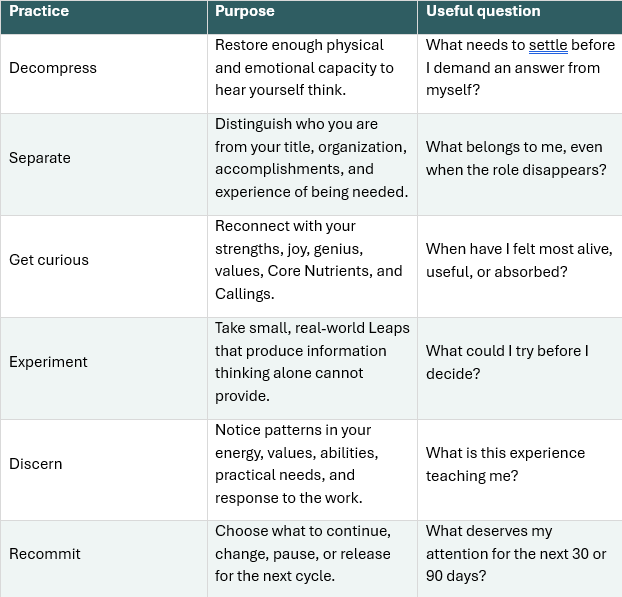
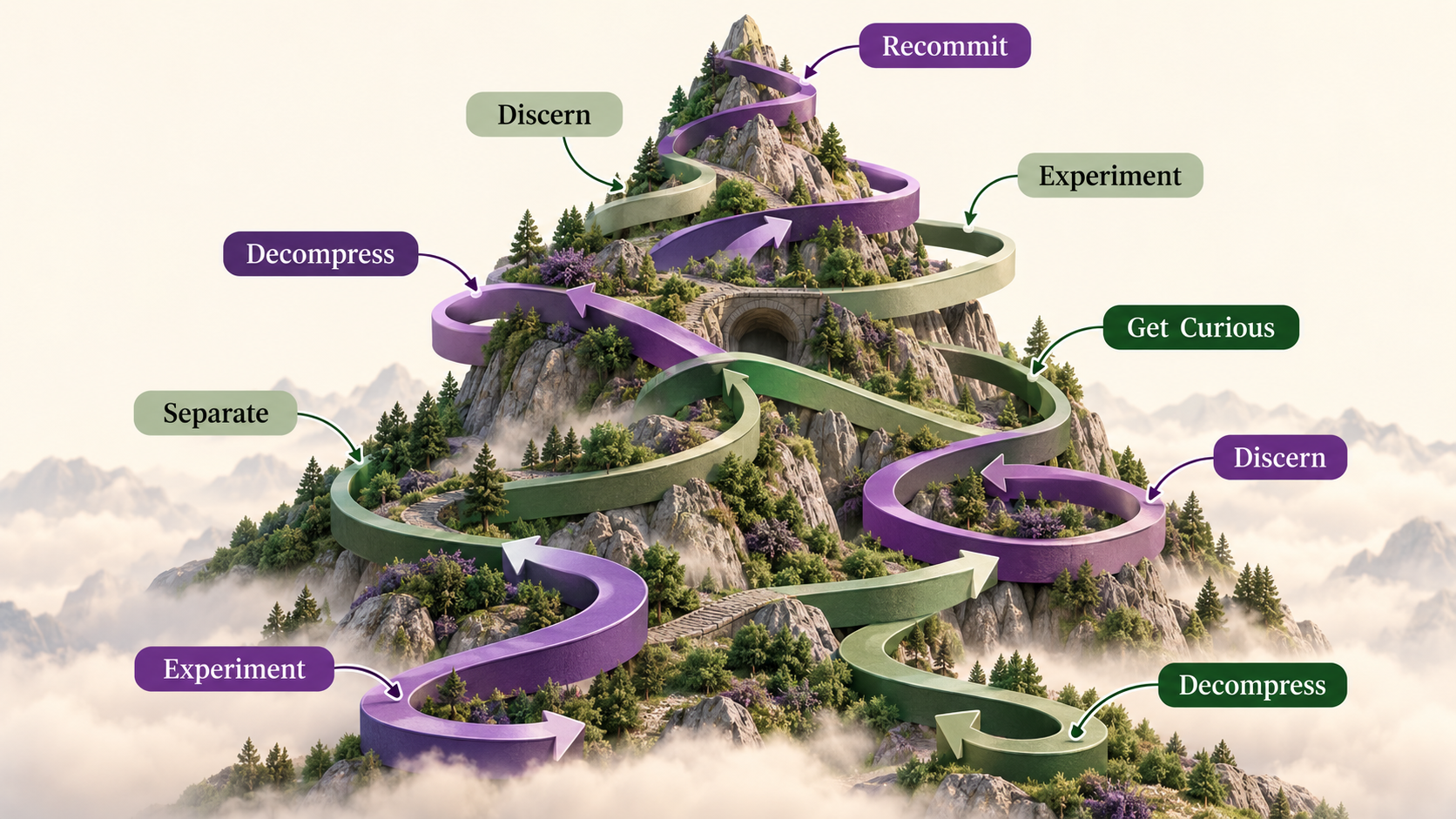
The Learning Space unfolds in cycles, not in a straight line. You may revisit the same practices many times, but each pass brings new information and a different perspective.
Decompress before demanding clarity
Clarity is hard to access when you are depleted. Yet many high achievers respond to career uncertainty by creating another ambitious work plan. They turn recovery into something else to achieve.
Decompression may include sleep, movement, time outside, unstructured thinking, nervous-system regulation, and the gradual return of activities that make you feel like yourself. Sometimes rest restores interest in the current job. Sometimes the same questions return after your energy improves. Both outcomes provide useful information.
Related: When you feel stuck and overwhelmed, start here
Separate your identity from your work
Overachievement can create opportunity, credibility, financial stability, and trust. The problem begins when achievement stops being something you do and becomes the main way you know who you are.
Identity separation does not mean rejecting your accomplishments. It means recognizing that your strengths belong to you, not to the institution that gave you a place to use them.
Related: I Don’t Know Who I Am Outside of Work
Get curious before narrowing the options
When clients tell me they do not know what they want, they rarely have no possibilities. More often, they have spent so long meeting expectations that they have lost contact with what energizes them.
Instead of immediately asking, “What job should I pursue?” ask, “When have I felt most alive, engaged, or useful, and what was present in those experiences?” Strengths, joy, genius, values, Tara Mohr’s Callings and Core Nutrients can all help you notice the thread.
Experiment through small Leaps
Some questions can only be answered through experience. A Leap, a practice drawn from Tara Mohr’s Playing Big, is a small action that lets you test an idea with real people in the real world.
A Leap might be one informational conversation, a short class, a workshop, a volunteer role, a small consulting project, a public piece of writing, or a new way of using your current role. The point is not to prove that your idea is correct. The point is to learn.
Related: Clarity Doesn’t Come First. It Comes From Action.
Discern what the experience is teaching you
An experiment can succeed and still reveal that the work is wrong for you. You may perform beautifully, receive enthusiastic feedback, and have no desire to do it again.
Discernment asks more than “Was I good at it?” Ask whether the work gave you energy, whether you liked the activity or only the idea of it, whether you enjoyed the people and environment, and whether the tradeoffs fit the life you want.
Recommit without pretending to be certain
Eventually, learning needs to influence action. Recommitment means choosing what deserves more of your time, attention, and courage during the next cycle.
You might commit to a direction for 90 days, run two more Leaps, develop a skill, or have five targeted conversations. Then you evaluate again. Commitment can be real without being forever.
A career transition can continue while you pay the mortgage
Sometimes the next responsible step is another job that looks a lot like the last one. You may need income, health insurance, stability, or breathing room. Taking that job does not mean you have failed to reinvent yourself.
You can run two tracks at once. One track handles the immediate job search and practical needs. The other preserves a small Learning Space for the work, purpose, or activity that may come after that job.
During a demanding season, the Learning Space may shrink to one conversation a month, a note in your phone, or ten minutes rereading your North Star Statement. A small thread still counts.
When work or family life interrupts the process
A day-job crisis can pull you back in. A child may need extra support. An elderly parent may become ill. Your partner may face a setback. Your own health or finances may require attention.
When that happens, the Learning Space may become smaller for a while. It has not disappeared. Going back to the drawing board does not mean going back to the beginning. You return with information you did not have before.
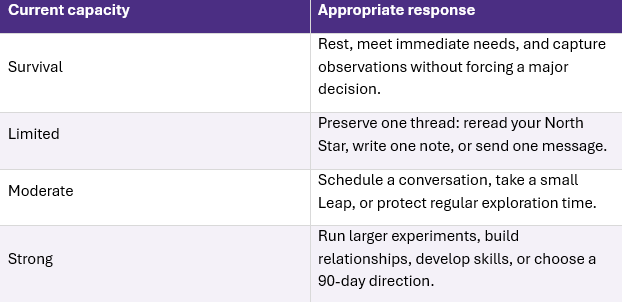
Your next step should match the capacity you have right now, not the capacity you wish you had.
A strong-capacity plan imposed on a survival-capacity week creates shame, not progress. Ask, “How can I remain connected to myself within the capacity I actually have?”
You can pause the work without abandoning yourself.
What this can look like in real life
One client I will call Maya began exploring a transition while leading a demanding team. I have changed identifying details and combined elements from more than one client to protect confidentiality.
Maya had started informational conversations and was becoming curious about advisory work. Then a major initiative at her company fell apart. She inherited more responsibility, worked late for several weeks, canceled two conversations, and stopped reviewing the notes she had made about her future. She decided she had lost momentum and was failing at her transition.
Her first need was not a new networking plan. It was decompression. Once the work crisis eased, she noticed that the experience had clarified how strongly she wanted autonomy, control of her time, and less dependence on constant organizational urgency.
The interruption had not erased the Learning Space. It had contributed new information. Maya revised her North Star Statement, designed a smaller Leap, and spoke with one independent advisor. That conversation did not settle her future. It helped her choose the next experiment.
Use a North Star Statement as a living hypothesis
A North Star Statement describes the direction you want to move based on what you currently understand about your strengths, joy, genius, values, Core Nutrients, Callings, desired contribution, and life needs.
It is not a job title, five-year plan, or prediction. It is a living hypothesis.
For example: “I want to use my ability to connect people and ideas to help accomplished women navigate meaningful transitions.”
After several Leaps, that statement might become: “I want to create intimate, thoughtful spaces where accomplished women can navigate meaningful transitions together.”
The revision does not mean the first version failed. Experience sharpened the direction.
Draft it. Say it. Test it. Notice. Revise it. Test it again.
Try one Learning Space cycle
Do not try to solve your whole future. Complete one cycle.
Check your capacity. Are you in survival, limited, moderate, or strong capacity right now?
Choose the practice this moment requires: decompress, separate, get curious, experiment, discern, or recommit.
Choose one action small enough to complete within your actual life.
Notice your energy, resistance, interest, feedback, and surprises.
Continue, revise, pause, release, or choose another practice for the next cycle.
Then repeat when you have more information or more capacity.
How to recognize progress
Progress may look like accepting a new position or launching a business. It may also look like:
recognizing that an attractive option does not fit;
admitting that you need more recovery;
rewriting your North Star Statement;
naming a financial or lifestyle tradeoff you will not make;
discovering that you enjoy a topic but not the day-to-day work;
sending one vulnerable message;
returning after an interruption without shaming yourself; or
choosing to stay in your current role on more intentional terms.
In the Learning Space, progress is not measured only by how quickly you reach an answer. It is measured by how honestly you respond to what you are learning.
Frequently asked questions
How long should a career transition take?
There is no universal timeline. The length depends on your energy, finances, family responsibilities, the size of the change, and whether you are exploring while employed. A useful timeline creates enough structure to keep learning without turning the process into another race.
How do I explore while working full time?
Match the experiment to your actual capacity. One conversation per month, a short class, or a small project may teach you more than an ambitious plan you cannot sustain. During intense work periods, preserve a minimal thread and return when capacity increases.
How do I know whether I am burned out or have outgrown my career?
Burnout often changes with meaningful rest and recovery. Misalignment tends to persist even after some energy returns. Notice whether time away restores your interest or whether the same questions keep returning.
What if a career experiment fails?
An experiment succeeds when it produces useful information. Learning that you dislike the work, environment, audience, or tradeoffs can prevent a larger and more expensive mistake.
When should I stop exploring and commit?
Consider committing more deeply when your interest persists beyond novelty, several experiences point in the same direction, the work uses strengths you want to keep using, and the practical tradeoffs are ones you can consciously accept. You still may not feel completely certain.
Continue exploring
I Don’t Know Who I Am Outside of Work
Feeling Stuck in Your Career? How to Start Moving Forward
Clarity Doesn’t Come First. It Comes From Action.
You do not have to navigate this alone
I coach accomplished women who are successful on paper but increasingly unsure whether their current path still fits. Together, we create room to hear what is changing, separate identity from achievement, test possibilities, and make thoughtful decisions that work in real life.
Learn what it is like to work with me
About Tracy Foltz
Tracy Foltz, PCC, is an executive and leadership coach who helps accomplished women navigate career and life transitions with greater clarity, courage, and self-trust. Before launching her coaching practice, Tracy spent more than 20 years at Microsoft in leadership, talent, operations, and learning roles. She combines firsthand experience of career transition with practical coaching tools that help clients separate identity from achievement, rediscover what matters, test possibilities, and build more intentional next chapters.
