
I Don't Know Who I Am Outside of Work: Why Career Transitions Are Particularly Hard for Overachievers
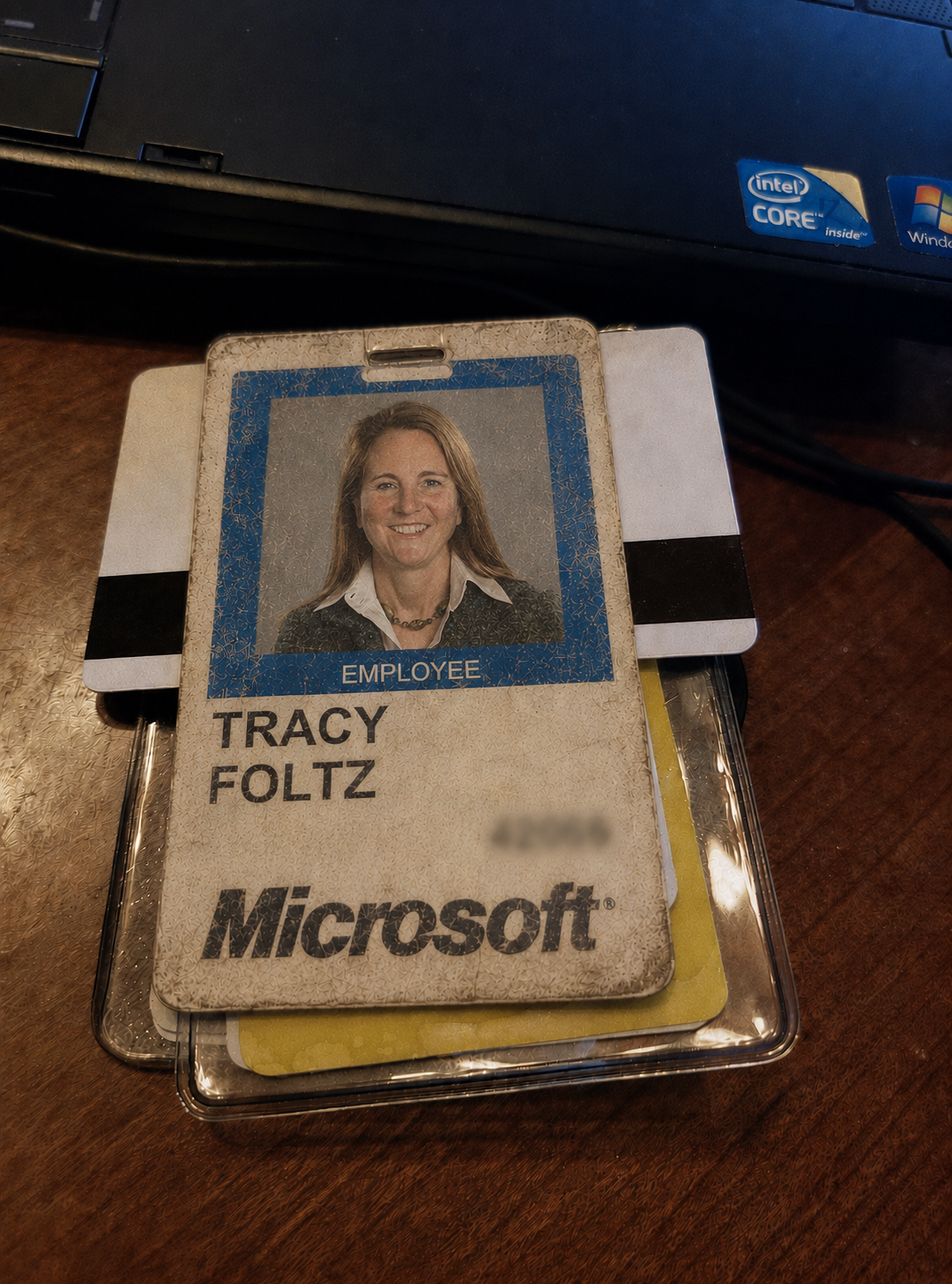
Before I left Microsoft, I was surprisingly hung up on one thing:
My blue badge.
That scratched, worn piece of plastic had been attached to me for more than 20 years.
How many mornings had I frantically searched the house for it while balancing coffee, a bagel, and the morning rush? How many meetings had I attended? How many airports had I passed through? How many times had I clipped the badge reel to my belt loop without even thinking about it?
I still smile remembering how my daughters used to steal my badge when they were little so they could play "meeting."
Somehow, even then, they sensed it was important.
Not because it opened doors.
Because it represented something much bigger.
Achievement.
Belonging.
Identity.
Success.
Security.
The thought of giving it up felt almost unimaginable.
At the time, I thought I was worried about leaving a company.
What I eventually realized was that I was worried about losing myself.
And that distinction matters.
Because for many high achievers, career transitions aren't just professional transitions.
They're identity transitions.
Why can a career transition feel like an identity crisis?
Career transitions can feel like identity crises when your work has become closely tied to how you see yourself. For high achievers and overachievers, a job can represent far more than income. It can provide identity, status, belonging, structure, purpose, and proof that you’re successful. When the job changes or disappears, it can leave you wondering who you are without it.
The Conversation Nobody Is Having
Right now, many professionals are evaluating retirement packages, buyout offers, career pivots, promotions, layoffs, or other major transitions.
The conversations tend to focus on practical questions:
Can I afford it?
What about healthcare?
Should I stay another year?
Will I find another role?
What happens to my stock?
Those are important questions.
But underneath them often sits a much quieter conversation:
Who am I without this company?
Who am I without this title?
Who am I without being needed every day?
Who am I when my calendar isn't full?
Who am I when my worth isn't measured by performance reviews, promotions, compensation, or accomplishments?
Those questions can feel surprisingly unsettling.
Especially for overachievers.
Why Overachievers Struggle More Than Most
Overachievers spend years developing an identity around achievement.
In many ways, that strategy has worked beautifully for as long as you can remember.
It creates success.
It creates opportunity.
It creates momentum.
It creates financial security.
It creates recognition.
The problem is that eventually achievement can become more than something you do.
It becomes who you are.
You stop seeing yourself as a person who accomplishes things.
You begin seeing yourself as your accomplishments.
And when that happens, career transitions become much harder.
Because now you're not just losing a role.
You're questioning your identity.
Success Becomes a Story
Over time, many high achievers develop a story about themselves.
I'm the reliable one.
I'm the problem solver.
I'm the person people count on.
I'm the successful one.
I'm the leader.
I'm the expert.
I'm the person with all the answers.
Those identities become deeply ingrained.
Then one day life asks a difficult question:
Who are you without those labels?
That question can create enormous anxiety.
Not because something is wrong.
Because something important is changing.
Stuck Is Often the First Signal
One thing I've noticed both personally and through coaching is that identity transitions often begin long before someone leaves.
They often begin with a feeling.
A nagging sense that something no longer fits.
A lack of excitement.
A growing restlessness.
An inability to recover fully from work.
A persistent question:
"Is this really it?"
Many people interpret these feelings as weakness, laziness, or burnout.
Sometimes they are.
But often they're information.
If that sounds familiar, you might enjoy reading my post: Stuck or Just Tired? 5 Signs You’ve Outgrown Your Career
Sometimes feeling stuck isn't a sign you've failed.
Sometimes it's a sign you've grown.
The Space Between Chapters
One of the most uncomfortable experiences for overachievers is the space between chapters: the period after an old identity starts fading but before a new one has fully formed.
I now think of this more broadly as The Learning Space for What’s Next: the uncertain but important space where you don’t have all the answers yet, but you can begin learning your way toward them.
The period after an old identity starts fading but before a new one has fully formed.
Most high achievers are extremely good at action.
We're good at solving.
Planning.
Executing.
Improving.
Optimizing.
The space between chapters asks something different.
It asks us to tolerate uncertainty.
To sit with questions.
To resist rushing into the next thing simply to avoid discomfort.
That can feel excruciating.
Because uncertainty often feels like failure to people who have spent their lives being successful.
Why We Try to Skip the Hard Part
Many people want certainty before they move forward.
They want a detailed roadmap.
A guaranteed outcome.
Proof that the next chapter will work.
Unfortunately, that's not usually how clarity arrives.
One of the biggest lessons I've learned personally is that clarity rarely comes before action.
It usually comes after.
After experimentation.
After conversations.
After exploration.
After trying things.
After paying attention.
That's why one of my most popular posts is: Clarity Doesn’t Come First. It Comes From Action.
You do not need a fully formed five-year plan to begin exploring what's next.
The Myth of Starting Over
Another fear I hear frequently is:
"What if I have to start over?"
The answer is almost always no.
You are not starting over.
You are bringing decades of wisdom, experience, judgment, resilience, leadership, and perspective with you.
The next chapter may look different.
But different is not the same as starting from scratch.
In fact, one of the most freeing realizations for many people is that they don't need to abandon everything they've built.
They simply need to apply it in a way that feels more aligned.
That's the central idea behind another post: You Don’t Need to Start Over: How to Redesign Your Career Instead
Why Overachievers Struggle With Rest
There is another layer that often surprises people.
Many overachievers don't just struggle with uncertainty.
They struggle with rest.
The absence of productivity can feel uncomfortable.
The absence of goals can feel uncomfortable.
The absence of urgency can feel uncomfortable.
Without realizing it, many high achievers begin measuring their worth by what they produce.
When productivity slows, anxiety rises.
That's why transitions often feel emotionally louder than expected.
You may find support in another article: How to Give Yourself a Break (If You’re an Overachiever)
Because sometimes the next chapter begins not with action, but with recovery.
When Fear Starts Running the Show
Transitions also create fertile ground for spiraling.
Your brain starts producing endless scenarios:
What if I regret this?
What if I fail?
What if I lose momentum?
What if nobody needs me?
What if I never figure it out?
What if I've made a terrible mistake?
The brain is trying to protect you.
But fear often masquerades as certainty.
That's why I've written before about the importance of recognizing when you're spiraling rather than problem-solving.
If that resonates, take a look at: When You’re Spiraling About What’s Next, Try This
What I Know Now
When my Microsoft chapter unexpectedly ended three and a half years ago, I didn't have a perfectly mapped-out vision for what came next.
I certainly didn't have all the answers.
What I did have was curiosity.
A willingness to experiment.
A willingness to tolerate uncertainty.
And eventually, the courage to build something more aligned with who I was becoming.
Today I get to spend my days helping leaders navigate transitions, discover what matters most, and create lives and careers that feel more intentional.
Ironically, many of the skills that made me successful at Microsoft came with me.
Leadership.
Listening.
Problem-solving.
Empathy.
Strategic thinking.
What changed wasn't who I was.
What changed was how I chose to use those strengths.
You Are More Than Your Job
If you find yourself facing a career crossroads, retirement decision, buyout offer, layoff, promotion, or major life transition, I want you to know something:
You are more than your title.
You are more than your company.
You are more than your productivity.
You are more than your achievements.
And while the space between chapters can feel uncomfortable, it can also become one of the most meaningful periods of growth in your life.
The goal isn't to figure out your entire future immediately.
The goal is simply to stay curious long enough to discover who you are becoming.
Because there is life outside of work.
And for many overachievers, that discovery becomes the beginning of something far better than they ever imagined.
Frequently Asked Questions
Why does losing a job feel like losing your identity?
Work can become closely tied to identity, especially for people who have spent years building a successful career. Your title, company, responsibilities, relationships, and accomplishments can all become part of how you understand yourself. When that structure disappears, it can take time to separate who you are from what you did.
How do I separate my identity from my career?
Start by noticing the qualities, strengths, relationships, interests, and values that exist independently of your job title or employer. Ask yourself what has remained true about you across different roles and stages of your life. The goal isn’t to make work unimportant. It’s to recognize that your career is one part of your identity, not the whole thing.
Is it normal to feel lost after leaving a successful career?
Yes. You may know that your previous role no longer fits before you know what should replace it. That uncertainty can be especially uncomfortable for high achievers who are accustomed to having goals, plans, and clear measures of success.
How do I figure out who I am outside of work?
Get curious before trying to create a new identity. Pay attention to what energizes you, what you miss, what you want more of, and what interests you when achievement isn’t the goal. Conversations, new experiences, old interests, and small experiments can all help you discover parts of yourself that may have received less attention while you were focused on your career.
How do I know what to do next after leaving a long career?
You don’t need to know the entire answer before you begin. Start with small experiments, conversations, and experiences that give you more information about what fits. Career clarity often develops through action rather than through thinking your way to a perfect plan.
You Don't Have to Figure It Out Alone
If this article resonates with you, you may be standing in a place that feels both uncomfortable and unfamiliar.
As someone who spent more than 20 years at Microsoft, wrestled with these questions personally, and ultimately built a new chapter that feels far more aligned with who I am today, I understand both the excitement and uncertainty that transitions can bring.
If you'd like a thought partner as you navigate your own crossroads, I'd be honored to help.
Schedule a complimentary exploratory conversation here.
No pressure. No obligation.
Just a chance to talk about where you are, what you're wrestling with, and what might be possible from here.
Your next chapter doesn't have to be fully visible before you begin moving toward it.
About Tracy Foltz
Tracy Foltz, PCC, is an executive and leadership coach who helps accomplished leaders, often women over 40, navigate career transitions, leadership challenges, and questions about what they want next. Before becoming a full-time coach, Tracy spent more than 20 years at Microsoft, where she coached and developed leaders while building her own successful corporate career.
